How Title Operations Can Handle Volume Spikes Without Scaling Headcount
September 8, 2026
Sponsored Content
By Snehal Joshi
Imagine a regional lender sends your agency 300 files that all need to close within two weeks. Or a builder you've worked with for years suddenly triples its order volume for the quarter. That's the kind of growth every agency wants—but it also creates an immediate operational challenge. Your team size hasn't changed, there are still only so many hours in the day, and clients are waiting for results.
The instinctive response is to bring on temporary staff, ask examiners to work overtime, or worst case, turn away part of the order. Each has a cost. Temps require ramp-up time before they can effectively support unfamiliar production functions.
Overtime burns out the team you'll need again next quarter. Turning away business teaches a client to send it elsewhere next time. None of them solve the real problem, the order is temporary, but the cost of answering it that way isn't.
Why Hiring Alone Is a Poor Answer
Permanent hiring makes sense when demand is durable. It's a poor answer when volume is a one-off. By the time new production staff are fully ramped, the order is filled and the surge has passed, leaving you either short-staffed at the peak or carrying payroll you can't justify next quarter. And these moments recur with new clients, seasonal pushes and portfolio deals. Treating each one as a hiring event gets expensive fast.
Variable Capacity, Not Variable Headcount
The more lasting fix is separating file volume from examiner hours. Technology can absorb the repeatable preparation work that consumes examiner time regardless of file complexity: classifying instruments, extracting and normalizing owner and parcel data, assembling a review-ready chain of title, and flagging gaps or exceptions before a file reaches review. Title professionals then review the evidence, resolve exceptions and make the final examination decisions. The judgment-intensive work that should remain with experienced title professionals.
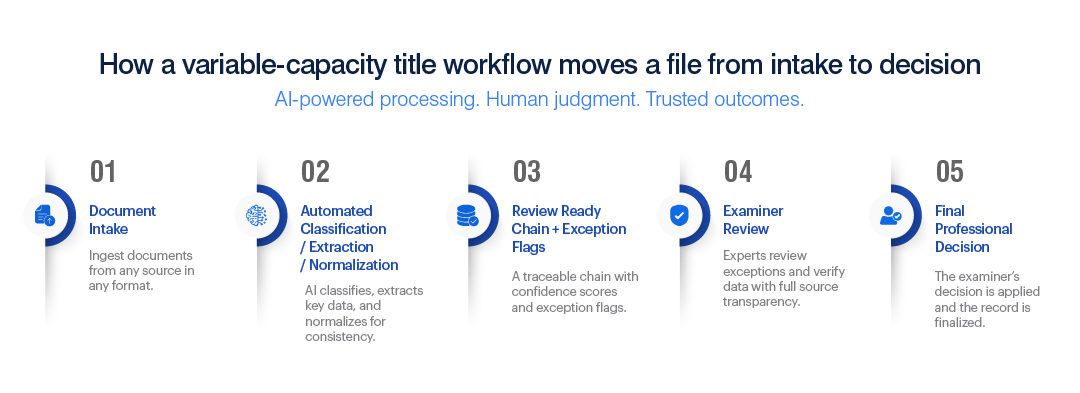 What This Looks Like in Practice
In Hitech i2i title workflows, roughly 60–70% of document-preparation work can be automated before professional review. Agencies using these workflows report up to two times examiner throughput without adding staff, with prepared files returned between one to four hours, versus a full-day workflow in many manual environments.
For Operations Managers Evaluating This Now
Ask these four questions the next time you receive a large order:
- What share of examiner time would go to prep work versus judgment work on this order?
- How does your realistic hiring and ramp timeline compare to the client's deadline?
- If the order ends tomorrow, would your cost structure come back down with it?
- Can exceptions be routed so examiner time stays concentrated where risk is highest?
The goal isn't zero hiring. It's not treating every big order as a staffing event. The agencies that handle these moments well aren't the ones hiring fastest, they're the ones who've already made capacity a function of technology, not headcount.
Calculate how many examiner hours you’re losing to prep work to get a better understanding of how Hitech’s i2i workflow can help your operation adjust to order volume changes and drive improved turnaround time.
Snehal Joshi is head of real estate data solutions at Hitech i2i, which an AI-powered property intelligence platform built to streamline property title search processes, organize instruments and prepare structured files for efficient real estate title examination. Joshi can be reached at [email protected].
Contact ALTA at 202-296-3671 or [email protected].